
A retirement paycheck is what transforms your savings into reliable monthly income throughout retirement. While most people spend decades building their nest egg, the real challenge begins when it’s time to turn those savings into a dependable paycheck that can support the lifestyle you’ve worked so hard to achieve.
One of the biggest questions retirees ask is:
“How do I turn my nest egg into a paycheck that lasts?”
The good news is that with the right strategy, you can create a retirement income plan that provides confidence and consistency for years to come. If you’d like to learn more about building a reliable retirement paycheck, be sure to watch Mike’s Michigan’s Retirement Coach Podcast on this topic, where he walks through each step in greater detail.
Step 1: Start with Guaranteed Income
Your retirement paycheck should begin with your most reliable income sources.
These may include:
- Social Security – The foundation of retirement income for many Americans.You can estimate your future benefits by creating an account with the Social Security Administration.
- Pensions – While less common today, pensions provide a dependable monthly benefit.
- Annuities – Certain annuities can provide guaranteed lifetime income and may be used alongside other retirement income sources.
Only after you’ve identified these guaranteed income streams should you begin withdrawing money from your investment portfolio.
This approach helps ensure your essential expenses are covered before relying on market-based investments.
Step 2: Identify Your Income Gap
Next, determine how much income you’ll actually need each month.
Think beyond just paying the bills. Consider the lifestyle you want to enjoy in retirement:
- Dining out
- Traveling
- Spending time with children and grandchildren
- Hobbies and entertainment
Once you’ve calculated your monthly expenses, subtract your guaranteed income.
Example:
- Monthly retirement expenses: $4,000
- Guaranteed income: $2,500
- Income gap: $1,500 per month
That $1,500 monthly gap is what your retirement savings need to provide.
Step 3: Create a Withdrawal Strategy
Rather than withdrawing money randomly, it’s important to have a structured plan.
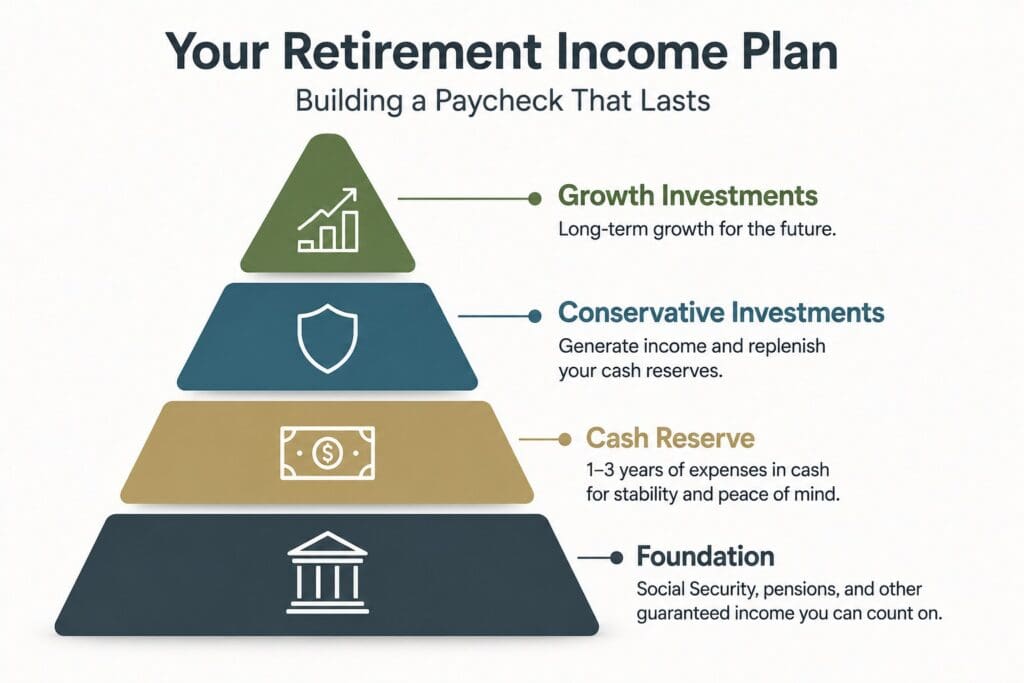
One helpful way to think about your retirement assets is as a financial house.
Foundation: Guaranteed Income
Your foundation is your Social Security, pensions, and guaranteed income sources. These provide stability throughout retirement.
First Layer: Short-Term Cash
Keep one to three years of planned withdrawals in cash or cash alternatives.
This allows you to continue receiving income even during market downturns without having to sell investments at depressed prices.
Second Layer: Conservative Investments
The next layer includes conservative investments such as bonds or other lower-risk assets.
These investments replenish your short-term cash reserves while continuing to generate returns.
Top Layer: Growth Investments
Your long-term growth investments, such as stocks, remain invested for future growth.
During strong markets, gains from this portion can replenish the conservative bucket, which in turn replenishes your cash reserves.
This layered approach helps reduce the impact of market volatility while maintaining a consistent income stream.
Step 4: Pay Yourself Every Month
One of the simplest ways to make retirement feel financially secure is to create a regular paycheck.
Set up an automatic monthly or bi-weekly transfer from your retirement accounts into your checking account.
Receiving income on a predictable schedule helps remove uncertainty and makes budgeting much easier.
Consistency often provides more peace of mind than trying to perfectly time every withdrawal.
Step 5: Review Annually—Not Constantly
Markets will fluctuate, but that doesn’t mean your retirement plan should change every time the headlines do. A well-designed retirement income strategy is built to help you navigate both good markets and bad, allowing you to stay focused on your long-term goals instead of reacting to short-term volatility.
Instead, schedule an annual review to evaluate:
- Changes in spending
- Inflation
- Investment performance
- Income needs
- Tax considerations
Most adjustments should be small, thoughtful course corrections rather than major changes.
As the saying goes, a massive ship changes direction one degree at a time—and retirement planning works much the same way.
A Simple Example
Imagine you’ve saved $1 million for retirement.
Your monthly expenses total $4,000, and Social Security provides $2,500 each month.
That leaves an income gap of $1,500 per month, or $18,000 annually.
In this example, your portfolio would only need to generate 1.8% annually to cover that gap. By following a structured withdrawal strategy—drawing first from cash reserves, then conservative investments, and finally growth investments—you can create a sustainable retirement paycheck while allowing the rest of your portfolio to continue working for you.
The Bottom Line
Creating a retirement paycheck doesn’t have to be complicated.
A simple framework can help:
- Identify your guaranteed income sources.
- Calculate your monthly income gap.
- Create a thoughtful withdrawal strategy.
- Automate your monthly paycheck.
- Review and adjust your plan once a year.
Knowing where your income is coming from each month can provide confidence and peace of mind throughout retirement.
If you’d like help building a retirement income strategy that’s designed around your goals, the team at LifePlan Financial Design